Science / Explained
The Gut-Brain ConnectionArticle 1 of 4

How does the gut read every meal?

The gut doesn't just digest a meal. It reads it. Every bite sends a message that travels through the whole body.

Food is an instruction manual for the body.

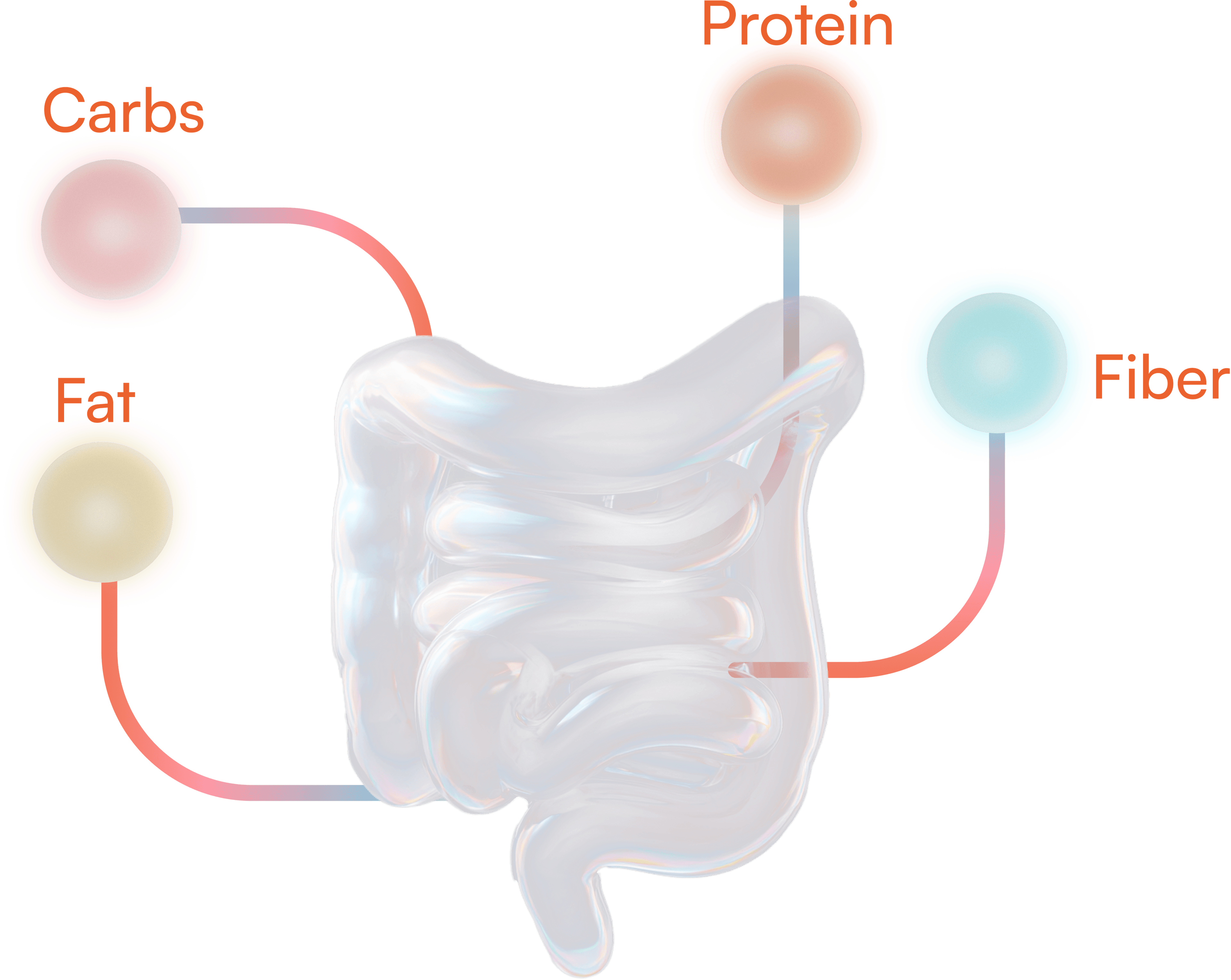
Fiber reaches the gut bacteria, which break it into smaller pieces. That unlocks the sensing cells in the gut lining and prompts them to put out hormones. Protein drives one of the strongest hormone responses. Fat drives a different one. Each nutrient is read separately.

The body doesn't pick those hormones at random. The food sets the response. Salmon triggers one cascade. A salad triggers another. A candy bar triggers a third. The gut is reading the chemical makeup of what it receives.

Meal composition is metabolic input. The gut makes the exact signals that tell the brain what just arrived. Feed it processed carbs day after day, and that becomes the manual the gut learns to follow. Feed it fiber and protein, and the gut learns a different one.

Food is a set of instructions. It sets which hormones the gut produces, and that sets which signals reach the brain.
One More Thing

The gut does not just detect that food arrived. L cells in the intestinal wall identify specific nutrients and put out a different hormone mix for each one. Protein drives the strongest GLP-1 response. Fat drives a different peptide mix that slows how fast the stomach empties. Fiber reaches the gut bacteria first, and they break it into short-chain fatty acids that set off a separate group of signals.

The gut reads the chemical makeup of every meal and writes a different metabolic instruction for each. Salmon and a candy bar produce completely different hormonal programs.

Next
What happens in four brain regions after one meal?
Related articles

Your Gut Has a Brain

The digestive tract has its own nerve network and sends a steady stream of information to the brain.

Read more

What happens in four brain regions after one meal?

Signals triggered by a meal do not stop in the gut. They reach several brain regions, each reading the same meal for a different purpose.

Read more

Why does 95% of serotonin live in the gut?

Most serotonin in the body is produced in the digestive tract. That fact is useful, but it only helps if the reader keeps location and function in view.

Read more

What Are Peptides? Your Body Runs on 7,000 Peptide Signals

A deep dive into how short chains of amino acids regulate hunger, blood sugar, pain, immunity, and tissue repair across the entire body.

Read more

Does the brain listen more than it talks?

Gut-brain communication is not mainly a one-way command system. Most of the traffic moves upward, from the gut toward the brain.

Read more
Keep building trust

Move from the science to the proof, source, and practical questions.

Science next

Your Gut Has a Brain

Keep the explanation moving with the next evidence-led Science article.

Keep learning

Science next

The GLP-1 Highway

Keep the explanation moving with the next evidence-led Science article.

Keep learning

Science next

Does Ozempic work on the brain beyond appetite?

Keep the explanation moving with the next evidence-led Science article.

Keep learning

Practical questions

FAQ

Use the FAQ for logistics, safety boundaries, and common buyer questions.

Read the FAQ
References2 sources
  1. Steinert, R.E., Feinle-Bisset, C., Asarian, L., Horowitz, M., Beglinger, C., & Geary, N. · 2017
    Ghrelin, CCK, GLP-1, and PYY(3-36): Secretory Controls and Physiological Roles in Eating and Glycemia in Health, Obesity, and After RYGB.
    Physiological Reviews, 97(1), 411-463, comprehensive review of macronutrient-specific gut-hormone secretion
  2. Chambers, E.S., Morrison, D.J., & Frost, G. · 2014
    Control of appetite and energy intake by SCFA: what are the potential underlying mechanisms?
    Proceedings of the Nutrition Society, 74(3), 328-336, fiber/SCFA pathway specifically

Disclaimer. This article is for educational purposes only and does not constitute medical advice. Peptide signals and their therapeutic applications are complex and context-dependent.